Mustafa Hammood
Photon wrangler, silicon sculptor, and software fidgeter
§ input
About
I'm Mustafa Hammood, a photonics designer in Vancouver, Canada. I specialize in integrated photonics (specifically silicon photonics) engineering and science with experience across design, layout, fabrication, testing, analysis, packaging and validation on silicon, silicon nitride and other platforms such as thin film lithium niobate.
My doctoral research, conducted at the University of British Columbia, focused on designing silicon photonic filters including adiabatic and Bragg filters using contra-directional couplers across various platforms with emphasis on manufacturing awareness and performance optimization for broadband (de)multiplexing applications.
Professionally, I design process design kits (PDKs), automation frameworks for component and layout design, lab automation frameworks, measurement data analysis tools, and compact model compilation using simulated and measured data alongside statistical analysis and integration into EDA PDKs.
I enjoy working on open-source projects and contributing to the community. I believe in the power of open-source as a means to accelerate innovation, democratize access to knowledge, and lower the barrier of entry to silicon photonics technology across many domains. I enjoy maintaining and contributing to open-source projects such as SiEPIC EPDA (and its associated PDKs and plug-ins) as well as enabling plug-ins to other open-source tools such as KLayout and GDSfactory.
§ devices · What I typically do in my work...
What I do
Design
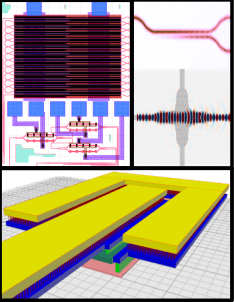
Photonic component design and layout development. Specialized in creating robust, manufacturing-aware designs for silicon photonic devices including filters, optical IO, polarization management, among others, using advanced design methodologies utilizing various numerical and analytical modelling methods and incoporating them in automation frameworks.
Characterization
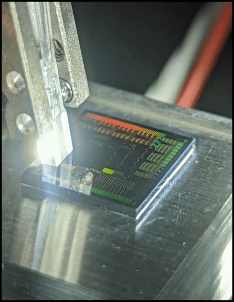
Building lab automation frameworks and measurement systems. Developing automated test setups, PIC probe station hardware configurations, and measurement routines and protocols for photonic device characterization and validation.
Validation
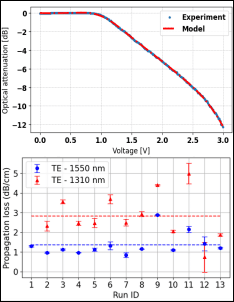
Validating test and measurement data through analysis and correlation to manufacturing-aware simulated results. Automating measurement vs simulation comparisons, data analysis workflows, and compact model compilation for PDK development and deployment.
Integration
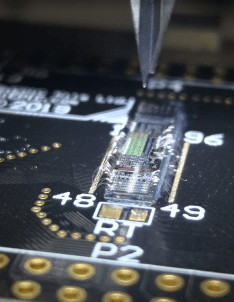
Designing for packaging and system integration. Background in photonic integrated circuit (PIC) packaging, fiber integration design, hybrid integration approaches, and collaborating with integration and packaging teams to optimize PIC performance and demonstrating hybrid integration approaches and applications.
§ instruments · interactive
Tools you can drive
Click for the full description, then launch the ones that run in the browser.
An open, programmable EDA (electronic design automation) platform built from scratch in Rust: a small core and launcher shell that host tools the way an editor hosts extensions, with documented APIs that scripts, tools, or AI agents can drive. Entropic is built to host a growing suite, schematic capture, simulation, library management, on one foundation; the layout editor is the first tool it ships. This web demo runs a subset of that layout tool, compiled to WebAssembly, an experiment in web-deploying a native Rust app, so performance is significantly slower than the desktop app. Launch a tool, open a .gds/.lyp, explore.
Full-vectorial finite-difference eigenmode (FDE) solver running entirely in your browser - the same published formulation (Zhu & Brown 2002) that commercial mode solvers build on, implemented matrix-free in TypeScript inside a Web Worker. Build any layer stack and waveguide geometry (rib, strip, stacked guides, sidewall angles), solve for modes with effective index and TE polarization fraction, inspect field profiles, and sweep any parameter.
Coupled ring resonator design and simulation tool with complete spectral analysis, real-time parameter control, and professional visualization capabilities.
Interactive 3D visualization of polarization states on the Poincare sphere with real-time manipulation, trajectory tracking, and professional export capabilities.
Finite-difference time-domain electromagnetic simulator for photonic device analysis with GDS layout integration and real-time visualization.
Coupling coefficient calculator for various waveguide geometries with sensitivity analysis and optimization suggestions.
§ output
Publications
41 publications in silicon photonics and integrated optics. The full list is a work in progress, but most can be found under various hubs of science ;)
§ open channel
Let's make light do something useful.
I'm always glad to talk about silicon photonics and the tooling around it, a collaboration or something we could build together, talk industry, or whatever's on your mind. If any of that resonates, say hello.
Start a conversation →